Patients ask whether therapeutic plasma exchange does anything they can actually measure. Here is one set of numbers, taken carefully before and after.
A woman in her mid-seventies finished four plasma exchange sessions over nine days, with albumin replacement and no IVIG. She ran a TruDiagnostic epigenetic panel about a week before the first session and again about two weeks after the last.
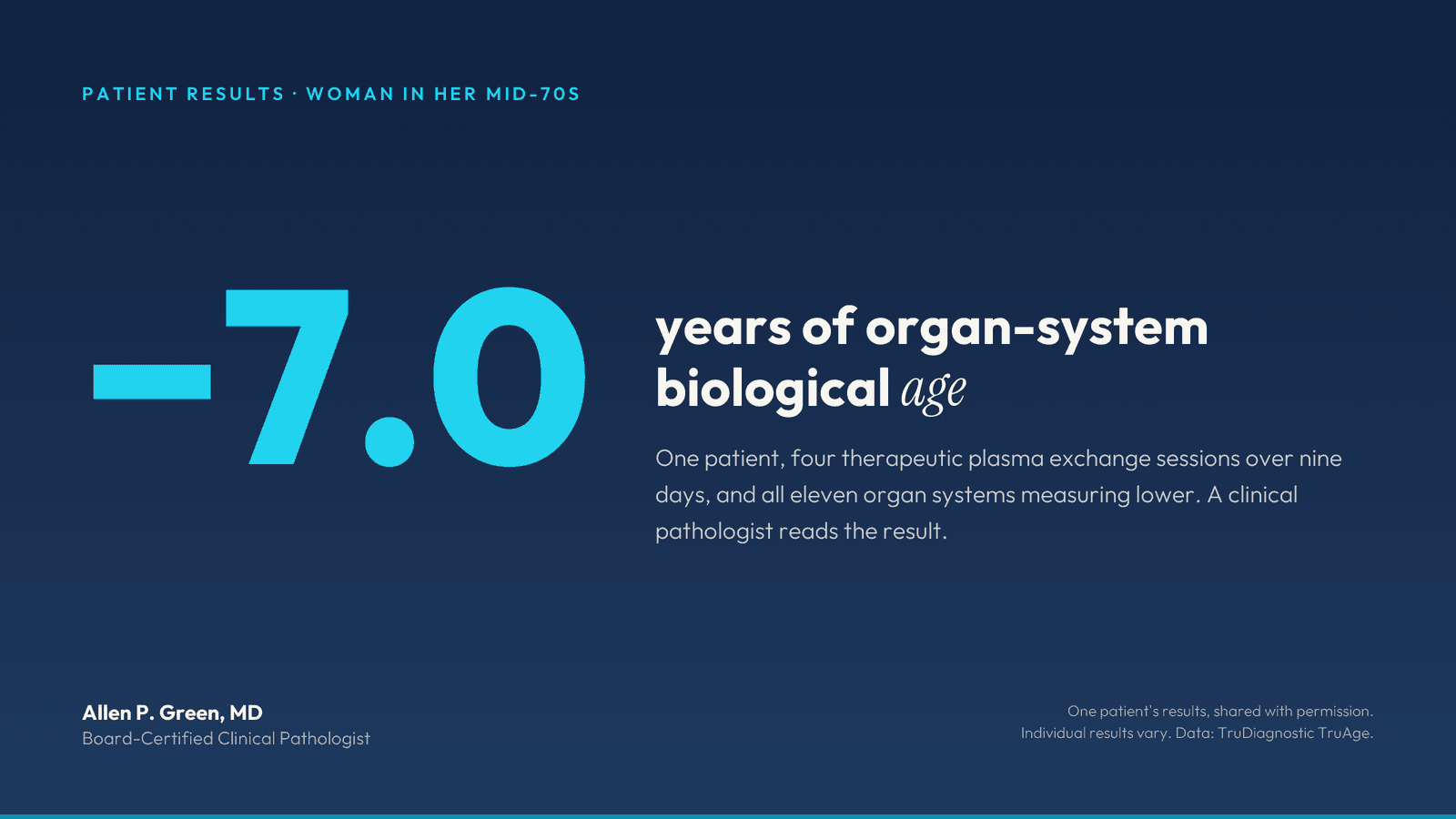
In short: her organ-system epigenetic age fell 7.0 years, from 70.5 to 63.5, and all eleven systems came back lower, while her pace-of-aging clock didn't move. This is one patient over about a month, so treat it as a measurement to examine rather than evidence that plasma exchange lowers biological age.
It helps to know what the panel measures. Some of these clocks estimate how much aging has accumulated, one estimates how fast it's running now, and a third set breaks the accumulated estimate out by organ system, all of it computed from methylation patterns in a single blood draw.
Every organ system came back lower
SYMPHONY Age estimates the biological age of eleven systems from one blood sample, and hers went from 70.5 to 63.5 against a calendar age of 76.8. Every system started below that number and moved lower still.
| System | Before | After | Change |
|---|---|---|---|
| Immune | 73.1 | 64.9 | 8.2 years lower |
| Liver | 68.5 | 61.2 | 7.3 years lower |
| Kidney | 69.4 | 62.6 | 6.8 years lower |
| Metabolic | 68.4 | 63.4 | 5.0 years lower |
| Lung | 71.3 | 66.5 | 4.8 years lower |
| Brain | 70.4 | 66.3 | 4.1 years lower |
| Hormone | 75.0 | 71.1 | 3.9 years lower |
| Inflammation | 67.3 | 64.1 | 3.2 years lower |
| Heart | 68.4 | 65.3 | 3.1 years lower |
| Musculoskeletal | 69.5 | 68.4 | 1.1 years lower |
| Blood | 66.9 | 66.7 | 0.2 years lower |
The other clocks
OMICm Age went from 59.5 to 57.6, telomere biological age from 59.2 to 55.7, and her estimated telomere length ticked up from 6.9 to 7.0. Those are smaller moves, and the spread between them is itself interesting: a 7.0-year drop and a 1.9-year drop came off the same blood draw on the same day.
What didn't move
DunedinPACE went from 0.71 to 0.72, which is flat, and I'm glad it is. It asks a different question than the others, estimating how fast aging is running now instead of how much has accumulated, and it reflects months of biology rather than nine days. Hers was already well under 1.0, the line where you age one biological year per calendar year, so four sessions were never going to shift it and 0.01 tells you nothing in either direction.
It's also useful as a negative control. If something about the procedure or the testing were pushing every number down indiscriminately, the pace clock is where I'd expect that to show, and it sat still.
Where this sits against the trial data
I've written up the Aging Cell trial itself elsewhere, so here is only what you need to read her numbers against it: 44 healthy adults over 50, four groups of roughly ten, six sessions each, and IVIG in one arm out of the four.
| Arm | IVIG | Average biological age | Organ-system clocks |
|---|---|---|---|
| Biweekly exchange plus IVIG | Yes | 2.61 years lower | 4.85 years lower |
| Monthly exchange | No | 1.32 years lower | 2.55 years lower |
| Biweekly exchange | No | No significant change | No significant change |
| Placebo | No | No significant change | No significant change |
The two exchange-only arms differ in spacing rather than dose, since every arm received six sessions, and the draws were taken before sessions 1, 4 and 6. So every figure in that table is measured after three sessions, and by the draw after five the advantage over placebo had gone.
That fits something I'd already been working on. If the benefit peaks around the third or fourth session and then gives ground, then for longevity indications four may be a better course than six, and her four land right at that peak with numbers that are consistent with it. Earlier proteomic work points toward six, so this is a live argument and not a settled one, but it's the question I most want answered and most of why I track this at all.
Her immune estimate fell 8.2 years on albumin alone. In that trial the per-system drops ran 2.5 to 5.3 years without IVIG and reached 9.7 years for the immune system with it, and the immune cell composition changes showed up only in the IVIG arm, so hers sits high for the protocol she had. I don't have an explanation for it.
How I read this
One patient, one month. These clocks carry real test-to-test variability, and a single before-and-after on one person can't separate a result from it, which is why I wouldn't read much into the 1.9-year OMICm shift on its own.
The immune numbers are the part I keep coming back to. Her profile moved toward more naive T cells and a lower neutrophil fraction, and immunosenescence runs the other direction: naive T cells deplete as you age while the neutrophil-to-lymphocyte ratio climbs. Hers went the opposite way on both.
That matters for how you read the clocks. Methylation is measured on the white cells in the sample, so changing which cells are in the sample moves the number, and a bulk blood test won't tell you which of those happened. My read is that the mix changed, and changed in the direction you'd want, since restoring naive T cells is one of the things I'd want this procedure to do.
Then there's the spread. The reduction itself is the headline and I don't want to talk past it, because only one trial has reported plasma exchange lowering biological age on well-validated epigenetic metrics and most physicians I talk to don't know it's been shown at all. A second dataset pointing the same way counts for something.
The spread is a separate finding sitting on top of that. All eleven scores come off one blood draw and one panel of about 125,000 methylation sites, so they aren't independent measurements. But Sehgal and colleagues, who developed this organ-system framework at Yale and published it in Nature Aging, trained each system separately, and they report that the systems correlate with each other unevenly. Heart and Lung sit at 0.76. Clustering puts Liver, Brain and Blood in one group and Metabolic, Inflammation and Kidney in another. Their whole point was that two people can share a chronological age and an identical overall score while looking completely different underneath.
Hers didn't respect those groupings. Heart and Lung, the tightest pair in the paper, moved together at 3.1 and 4.8 years. Liver and Blood sit in the same cluster and came out 7.1 years apart, 7.3 against 0.2. So the question becomes what's causing the difference between organ systems.
What she said
She didn't come in for a number. She came in for the inflammation behind a painful shoulder, and in her words: "The shoulder is better. Pain is down to a 3 from a 9. Range of motion has increased." She was sleeping better and still recovering when she wrote that.
What's next
Durability is the whole question and this can't speak to it. Two weeks out is a close-in reading, taken while the effects of the exchange itself are still settling, so it tells you what changed and not what stuck. She's retesting in a few months and again later in the year, and I'll publish those numbers either way, including if they go the wrong direction.
This is the kind of before-and-after I want on every patient willing to do the testing. For the wider evidence base instead of a single case, start with the research on TPE and the longevity application page, and I've written separately on what we can and can't measure with this procedure.
One patient's results, shared with written permission. Individual results vary and don't predict outcomes for anyone else. Epigenetic age estimates come from a commercial laboratory test and are not FDA-cleared measures of disease or lifespan. TPE for longevity indications is not FDA-approved and is not covered by insurance. This post is educational and is not medical advice.