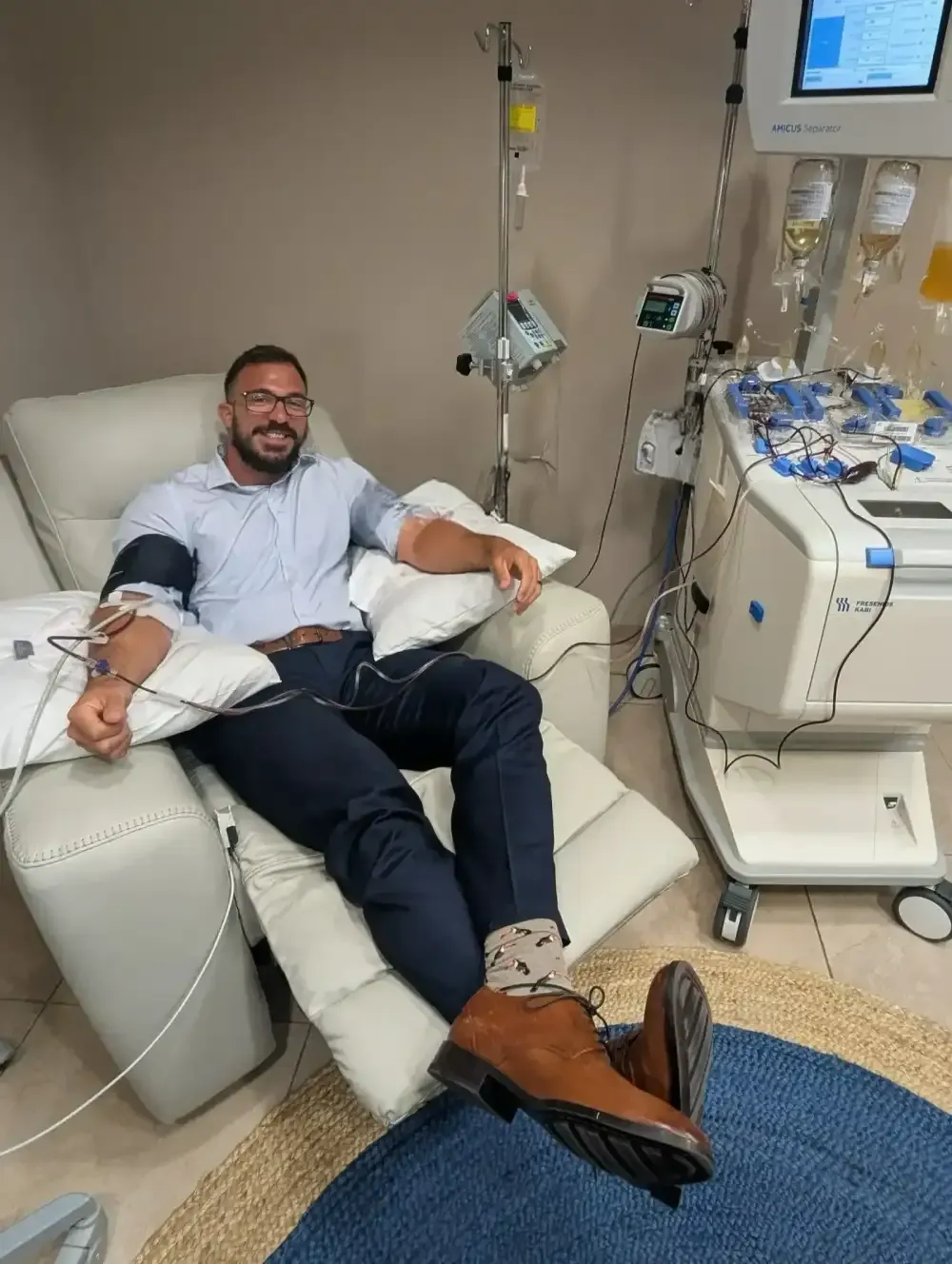
Joe Rogan recently posted about receiving plasmapheresis at a clinic in Texas, holding up bags of his removed plasma and describing the procedure as "changing the oil in your body."
Within hours, my phone started buzzing.
Some messages were from friends who had never heard of the procedure. Some were from patients who wanted to know if what Rogan described was the same thing I do every week. And some were from people who had already started Googling and had run into more questions than answers.
This is what happens when therapeutic plasma exchange enters the mainstream. The interest arrives all at once, and the clinical context takes longer to catch up. So rather than writing another full explainer on what TPE is (I've done that elsewhere on this site, and I published a detailed response on the Global Apheresis blog as well), I want to answer the questions I'm actually seeing.
"Isn't this just dialysis?"
No. They're fundamentally different procedures, even though both involve circulating blood through a machine.
Dialysis filters small waste molecules (creatinine, urea, excess electrolytes) across a semipermeable membrane because the kidneys can no longer do that job. It targets small solutes.
Therapeutic plasma exchange does something different entirely. It separates your blood into cells and plasma, discards the plasma along with everything dissolved or suspended in it, and replaces it with a fresh solution: typically 5% human albumin. Your blood cells are returned to you. The targets are large molecules that dialysis can't touch: autoantibodies, inflammatory cytokines, complement proteins, albumin-bound toxins, and the accumulated signaling molecules that shift your internal environment as you age.
Same general category (extracorporeal blood procedure), but different mechanism, different machine, different purpose.
"Don't your liver and kidneys already do this?"
They do an extraordinary amount. Your liver metabolizes drugs, processes bilirubin, clears damaged proteins, and detoxifies a wide range of compounds. Your kidneys filter roughly 180 liters of plasma per day, recovering what the body needs and excreting what it doesn't. These organs are remarkably good at what they were designed to do.
But they have specific capabilities and specific limits. Your liver and kidneys were not built to clear autoantibodies that your own immune system is actively producing. They don't remove inflammatory cytokines that are part of normal signaling cascades. They can't eliminate synthetic chemicals like PFAS that bind tightly to albumin and have biological half-lives measured in years, not hours. And they don't address the broader shift in plasma composition (the accumulation of pro-aging factors and the depletion of protective ones) that research has increasingly linked to biological aging.
TPE doesn't replace your organs. It does something your organs were never designed to do: remove the plasma itself and replace it with something clean.
"Is this the same thing as donating plasma?"
The first step is similar: your blood is drawn, run through an apheresis machine, and separated into cells and plasma. But that's where the overlap ends.
When you donate plasma, your plasma is collected and kept. Your cells are returned with a relatively small volume of saline. The goal is to harvest your plasma for manufacturing: it will be used to produce medications for someone else.
Therapeutic plasma exchange removes a much larger volume of plasma (typically one full plasma volume per session) and replaces it with 5% human albumin. The increased volume is part of what makes TPE therapeutic: you're not just removing a sample, you're exchanging the bulk of your circulating plasma in a single session. And the replacement fluid matters as much as the removal. Albumin is not an inert filler. It is one of the most potent antioxidants and anti-inflammatory compounds in the human body. It binds and neutralizes free radicals, transports hormones and fatty acids, and helps maintain vascular integrity. So the replacement itself confers benefit: you're not just taking something bad out, you're putting something good back in.
You walk out with the same blood volume you started with. The composition of your plasma is what's different.
"Is it safe?"
Yes, with an important caveat. TPE has been used in clinical medicine for decades. It is an established treatment with formal indications and safety guidelines published by the American Society for Apheresis, which currently recognizes over 100 clinical indications for therapeutic apheresis. The procedure has a well-documented safety profile across thousands of treatments at our clinic.
But "safe" is not an inherent property of the procedure. It's an outcome of how the procedure is performed. Vascular access has to be managed properly. Anticoagulation has to be titrated. The replacement fluid has to be appropriate for the patient. Vitals have to be monitored throughout. And someone with clinical judgment has to be making real-time decisions, not following a script.
This is the part of the conversation that gets lost in a social media post, and it's the part I'd most want you to hear. TPE is safe when it's performed by an experienced team in an appropriate clinical setting with physician oversight. The procedure itself is straightforward. The judgment behind it is not.
I've since written a fuller answer to this question, walking through the published safety data and the questions worth asking any clinic: is plasma exchange safe?
I've supervised over 500 TPE procedures. I trained in therapeutic apheresis at UT Southwestern Medical Center, which has one of the most respected apheresis training programs in the country. At Global Apheresis, I work alongside Dr. Dobri Kiprov, who is one of the physicians who established this field and has overseen more than 15,000 treatments over the course of his career. I mention this not to credentialize myself, but because when you're evaluating where to have this done, the experience and training of the team is the single most important variable, and the reason is more specific than you might expect.
TPE is not a one-size-fits-all procedure. The number of sessions, the frequency, and the replacement protocol should be tailored to the individual patient based on their labs, medical history, and clinical goals. Some clinics will offer whatever number of treatments they think will get someone through the door. But the reality is that a single one-off procedure is unlikely to produce meaningful benefit for most applications, and too many procedures performed too frequently is wasteful and potentially counterproductive. Getting the protocol right requires clinical experience and honest judgment, not a sales funnel.
"Is this just a rich-person biohacking thing?"
I understand why it looks that way. A celebrity posts about it, the procedure is cash-pay, and the setting looks nothing like a hospital. I get the skepticism.
But therapeutic plasma exchange is not new, and it's not fringe. It has been used to treat myasthenia gravis, Guillain-Barré syndrome, thrombotic thrombocytopenic purpura, and dozens of other serious conditions for decades. The American Society for Apheresis publishes evidence-based guidelines covering over 100 indications for therapeutic apheresis. This is a well-established medical procedure with a deep evidence base.
What's newer is the application of TPE to aging, cognitive decline, and environmental detoxification, and the research supporting those applications is growing. The AMBAR trial demonstrated that TPE slowed Alzheimer's progression by 52–71% across key outcome measures in a 322-patient trial. Those results were subsequently replicated in a real-world cohort of 32 patients in Argentina, where researchers observed 45% less cognitive decline and significant preservation of memory, language, and executive function compared to historical controls, with no cases of the brain swelling side effect associated with monoclonal antibody treatments. Studies published in GeroScience and Aging Cell have shown measurable reductions in biological age following TPE. And the data on PFAS removal through plasma-based interventions is the most promising avenue currently under investigation for a class of chemicals our bodies were never designed to clear.
What Does Plasmapheresis Cost?
The cost question is real, and it deserves a straight answer.
Therapeutic plasma exchange for longevity, cognitive optimization, and detoxification is typically not covered by insurance. These are considered elective applications, even as the evidence base grows. TPE is covered by insurance for many of its established autoimmune and neurological indications, but for the applications that are driving most of the current interest (aging, Alzheimer's prevention, PFAS removal), you should expect to pay out of pocket.
The cost of a single TPE procedure varies significantly depending on where in the country you look, ranging from approximately $6,000 to $12,000 per session.
Most patients pursuing longevity or detoxification applications will need a series of treatments, not just one session. So the total investment depends on the protocol recommended for your specific situation. If you want to understand what a protocol would look like and what it would cost in your case, that's exactly what our discovery call is for. No pressure, no commitment: just an honest conversation about whether this makes sense for you.
"The best thing a viral moment can do is make people ask better questions."
What I'd Want You to Know Before You Call Anyone
If you're considering TPE, whether because of Rogan's post, the Goop article, or your own research, here's what I'd want you to ask any provider before booking:
Who is supervising the procedure? A physician should be involved in your evaluation and available during treatment. Ask about their training in apheresis specifically, not just their general credentials.
How many procedures has the team performed? Volume matters in apheresis. The complications that do occur are almost always manageable when the team has seen them before.
What machine are they using? FDA-cleared apheresis devices like the Fresenius Amicus Separator are purpose-built for therapeutic plasma exchange. Be cautious of clinics using improvised setups or devices not designed for full-volume plasma exchange.
What replacement fluid are they using, and why? Standard of care for most TPE applications is 5% human albumin. If a provider is using a different replacement strategy, they should be able to explain the clinical rationale.
What does the evaluation look like before treatment? A responsible provider will want to review your labs, medical history, and goals before recommending a protocol. If someone is willing to start treatment on the first visit with no evaluation, that should give you pause.
How are they determining the number and frequency of treatments? This is where clinical judgment matters most. The answer should be individualized to you, not a fixed package that every patient receives regardless of their situation.
These aren't trick questions. Any qualified provider will welcome them.