I have notebooks from medical school with the words "It's in the blood" written in them.
Not as a metaphor. As a hypothesis.
I'd been following the parabiosis research: the studies connecting old and young animals and watching aging transfer between them through shared circulation. The science was pointing at something that felt almost too simple: aging isn't just happening to your cells in isolation. It's happening in your blood. It's systemic. It's fluid. Which meant, theoretically, it could be addressed.
One name kept appearing on the studies that mattered most. Dr. Dobri Kiprov. And he wasn't just publishing. He was promoting therapeutic plasma exchange as a clinical response to what the research was showing.
That clicked for me in a way I couldn't ignore.
The field that oversees plasma exchange is transfusion medicine, a subspecialty of clinical pathology. I had never been exposed to it in medical school. I chose it anyway. I built my entire residency around getting to this point.
Here's what I didn't expect: when I brought these studies to my mentors during residency, they laughed.
Not dismissively. Actually laughed.
Years later, when circumstances led me to apply for a fellowship at the same program, that same mentor turned me down. His stated reason: my goals did not align with the program's.
He was right. They didn't. My goals were to actually treat patients with what the evidence already showed was possible. His program wasn't interested in that.
There's wisdom in that careful approach. There's also a cost, and it's paid by patients, not academics. Alzheimer's disease progresses at roughly 3-4 points per year on the cognitive scale we use to measure it. Every year of deliberation is a year of decline. Every conference where the evidence is debated is a year in which someone's mother stops recognizing her children. The field moves carefully. The disease does not.
While my mentors were unconvinced, Dr. Kiprov was in private practice in Mill Valley, treating patients with Alzheimer's disease. Treating patients with long COVID before most people had a name for what was happening to them. Publishing results. Changing lives. Not waiting for the field to catch up.
That distinction matters more to me than I can easily explain. The science is what exposed me to this work. But it wasn't the science alone that made me plan my career the way I did.
It was that he was doing something about it.
Academia won't treat aging. It will study it indefinitely, and patients will wait. Dr. Kiprov decided decades ago that waiting was the wrong choice. He went out and built something.
When the opportunity came to join him at Global Apheresis, I didn't hesitate.
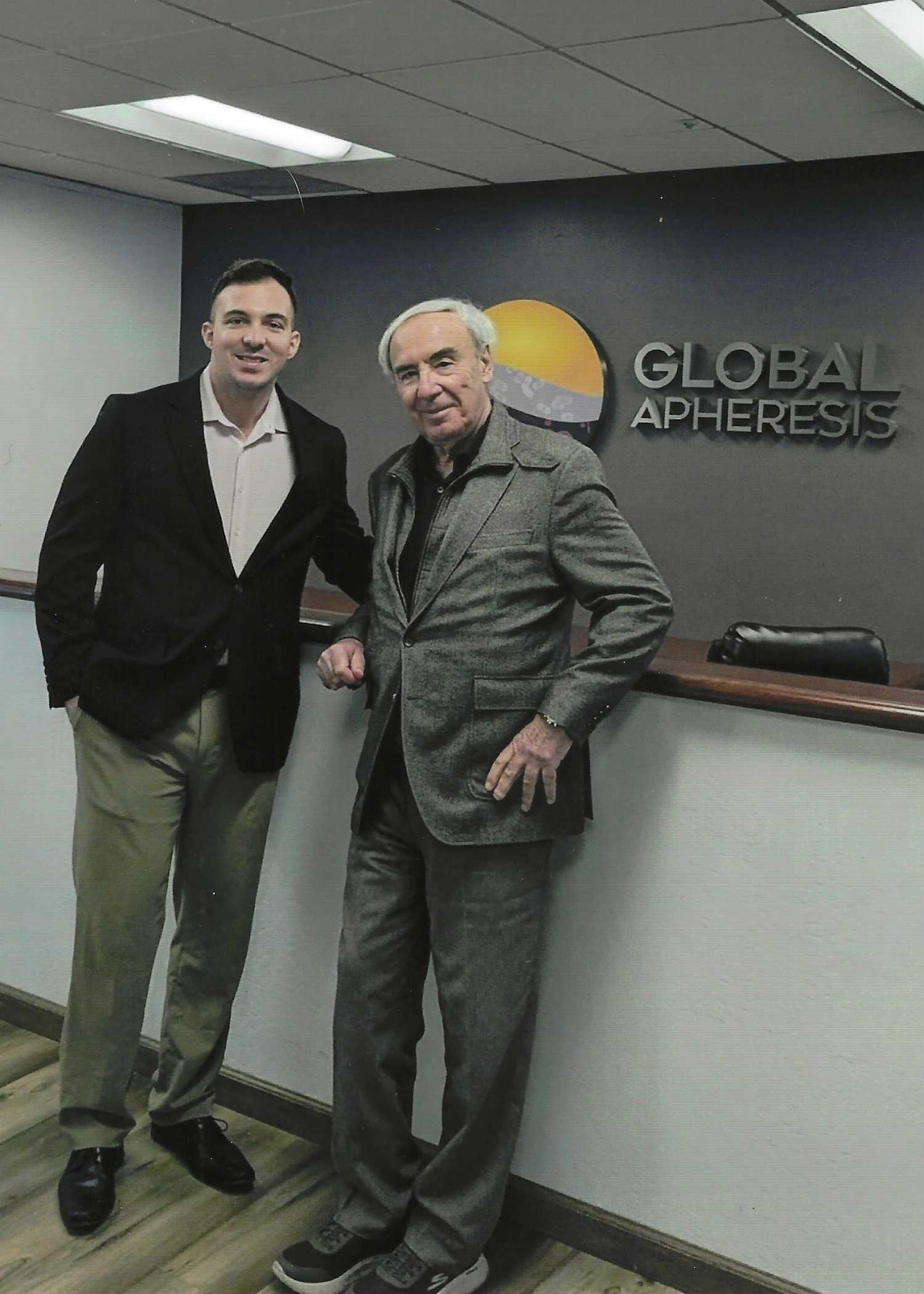
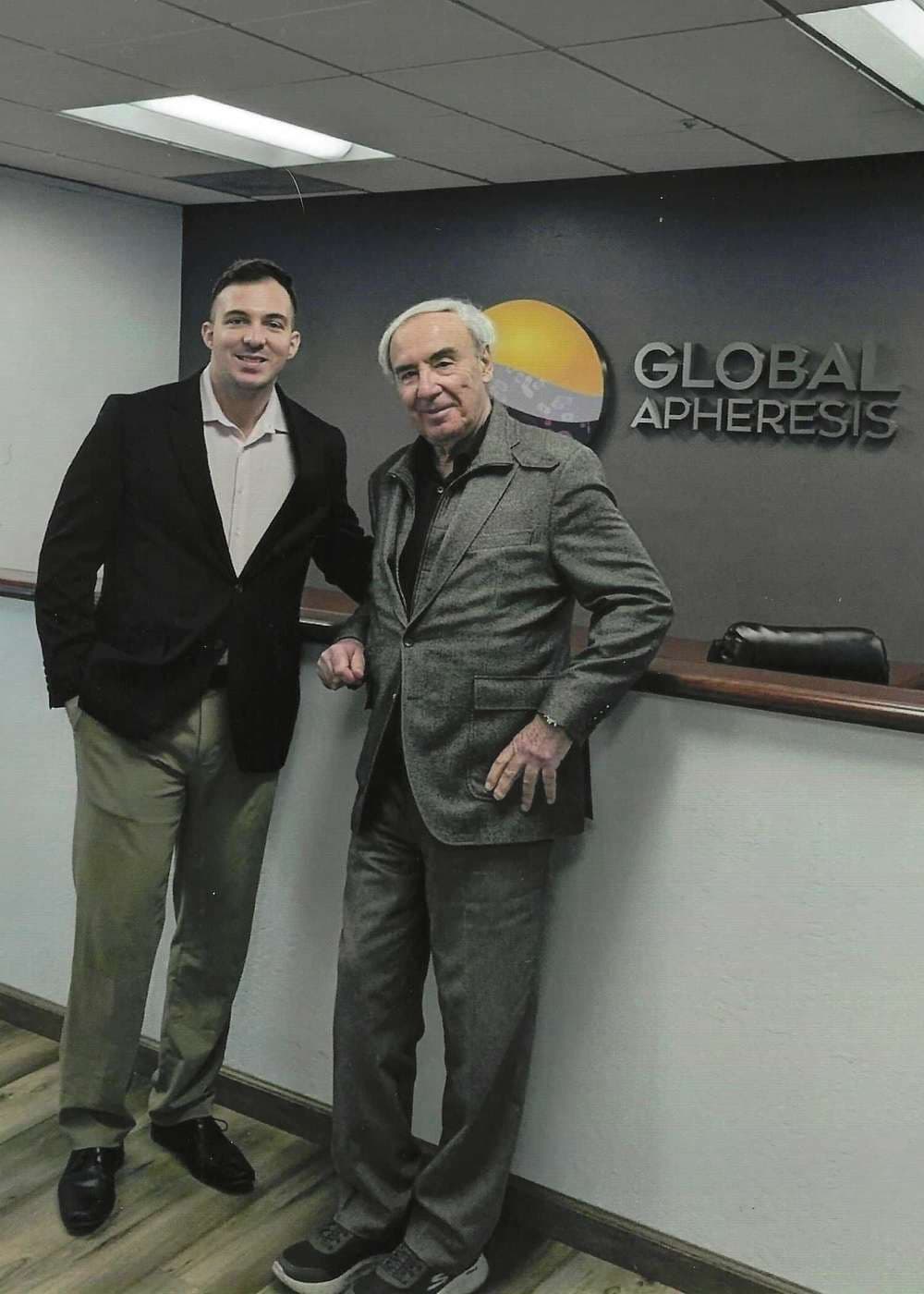
Working alongside Dr. Dobri Kiprov at Global Apheresis
I'm a board-certified clinical pathologist who specialized in therapeutic apheresis specifically because I believed the science pointed here, and because I saw how much providers need a practical roadmap for implementing TPE in their own practice. I've spent years training for exactly this. And now I work alongside the person whose work convinced me this was worth spending a career on.
What we offer at Global Apheresis is grounded in published, peer-reviewed research, and that research is no longer a single study. It has been replicated.
For Alzheimer's disease: the AMBAR trial demonstrated 52-71% slowing of cognitive and functional decline. In 2025, Taragano and colleagues published a real-world cohort study in the Journal of Alzheimer's Disease showing independent confirmation of those results: 45% less cognitive decline and 88% less memory deterioration compared to controls, in a completely separate patient population in Argentina. The AMBAR results were not a one-off. They held in the real world.
For biological age reversal: the GeroScience study showed measurable reduction in biological age following therapeutic plasma exchange. In 2025, a randomized placebo-controlled multi-omics trial published in Aging Cell, conducted with the Buck Institute for Research on Aging, with Dr. Kiprov as co-author, confirmed and extended those findings. Fifteen separate epigenetic clocks showed significant rejuvenation compared to placebo. The age reduction was not a fluke. It was reproducible, measurable, and mechanistically explained across the epigenome, proteome, metabolome, and immune system.
The science exists. The replications exist. The outcomes are documented. Across the full range of TPE applications, from Alzheimer's to longevity to autoimmune disease to detoxification, the evidence base continues to grow.
What has been missing is access, and someone willing to say clearly: we already know enough to help you. Come in.
That's what I'm here to say.
Ready to learn more? Book a discovery call to discuss whether therapeutic plasma exchange is right for you.
Dr. Allen Green is Associate Medical Director at Global Apheresis, serving patients in Mill Valley, San Francisco, and the greater Bay Area. He is a board-certified clinical pathologist specializing in therapeutic apheresis.