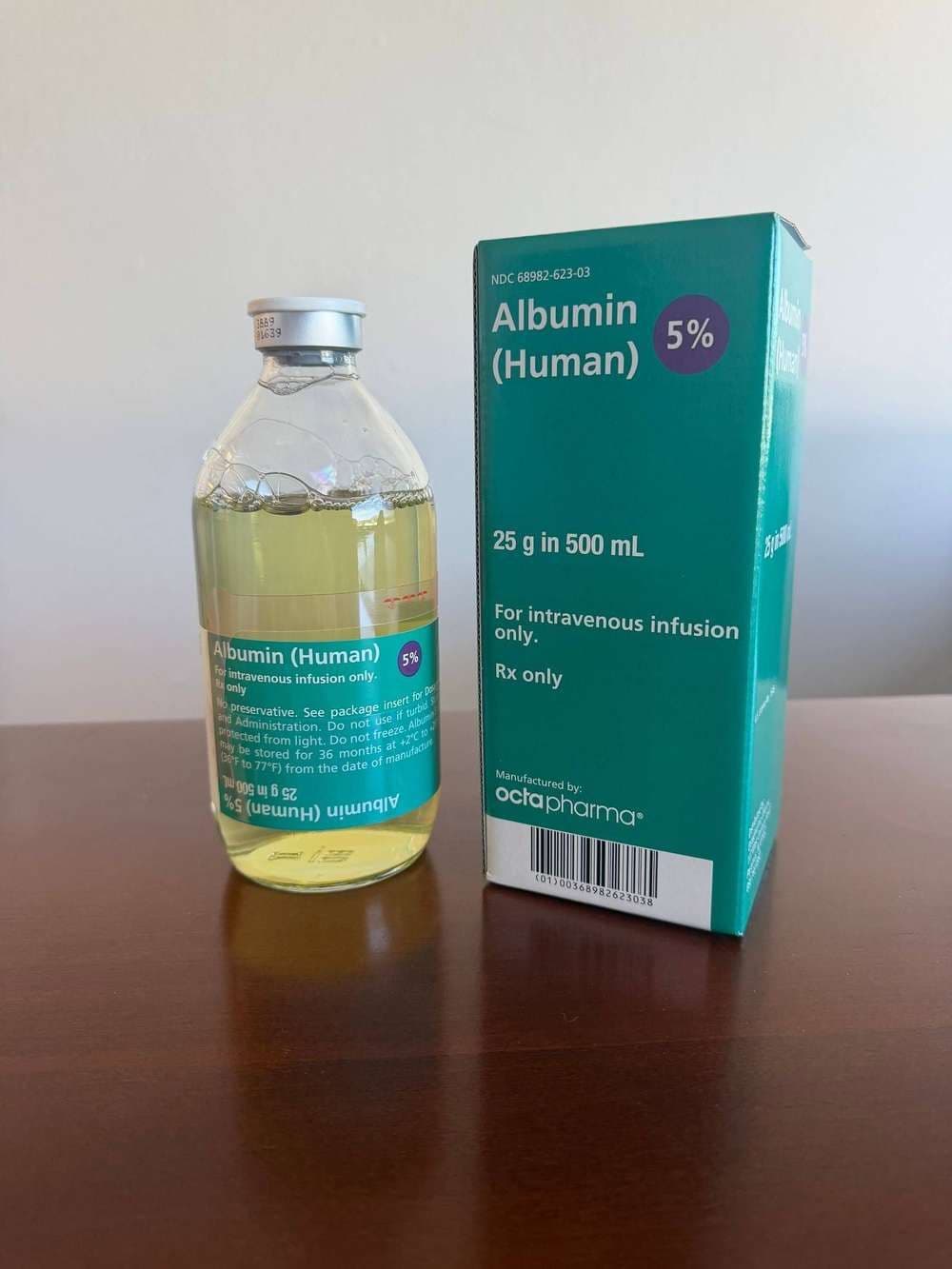
One of the most common questions I receive from patients concerns the 5% albumin we use as a replacement fluid during therapeutic plasma exchange. Being a human-derived product raises several questions for people. They want to know where it comes from, how it's processed, and whether it carries any risk of infectious disease. Some ask specifically about spike protein or vaccine-related contaminants.
These are reasonable questions. Here is what you need to know.
While albumin is human-derived, it is processed and manufactured in such a way that we tend to think of it more as a pharmaceutical product than a blood product. By the time it reaches your IV line, it has been through a transformation that is unrecognizable from the original donation.
In short: yes. The 5% albumin used in plasma exchange is considered very safe. It comes from screened, tested donor plasma and is then purified through cold ethanol fractionation, ion-exchange chromatography, terminal pasteurization, and nanofiltration, redundant steps that each remove pathogens. Every FDA-licensed lot is tested before release.
Where Albumin Comes From
Most albumin is derived from donor plasma collected in the United States, which is the world's largest source of plasma.
Donors are extensively screened before any plasma is collected. This includes detailed health history questionnaires covering general health and risk factors for infectious diseases. The donated plasma itself is also directly tested for HIV, hepatitis B, hepatitis C, and other pathogens. Donors who test positive are permanently deferred, and their plasma is never used.
Once collected and cleared, the plasma is pooled from many donors and shipped to pharmaceutical manufacturers for processing. Companies like Grifols, CSL Behring, and Octapharma operate large-scale fractionation facilities. What happens next is a multi-step manufacturing process that explains why we think of albumin the way we do.
How Albumin Is Manufactured
The safety of albumin is not built on any single safeguard. It is built on a series of redundant steps, each of which would independently eliminate most pathogens and contaminants. Together, they produce an exceptionally pure product.
Step 1: Cold Ethanol Fractionation
The Cohn cold ethanol fractionation process was developed in the 1940s and has been refined continuously since. It is the foundation of plasma protein manufacturing.
By precisely adjusting temperature, ethanol concentration, and pH, plasma is separated into distinct protein fractions. Albumin concentrates in one fraction. Immunoglobulins concentrate in another. Clotting factors in others.
This is not just a separation step. It is also a purification step. Cellular debris, lipoproteins, large protein complexes, and most contaminants are removed here. This includes spike protein, which is a large, complex molecule that would not survive fractionation intact.
Step 2: Ion-Exchange Chromatography
The albumin fraction is then passed through ion-exchange columns. These use charged resins that selectively bind residual impurities, allowing purified albumin to pass through. Trace proteins, nucleic acids, and any contaminants that survived fractionation are removed at this stage.
After this step, the solution is predominantly albumin.
Step 3: Pasteurization
The albumin solution is heated to 60°C for 10 hours in its final container. This is terminal pasteurization, meaning it happens after the product is sealed. Nothing can be introduced afterward.
This step is effective against a broad spectrum of viruses, bacteria, and other pathogens. Albumin is one of the few plasma proteins stable enough to survive pasteurization without losing function. This is a significant advantage over other blood-derived products. Immunoglobulins, for comparison, would be destroyed by this process, which is why IVIG requires a different inactivation approach.
Step 4: Filtration and Final Testing
After pasteurization, the albumin undergoes nanofiltration and a full battery of final product testing. Every lot is tested for sterility, pyrogenicity, protein concentration, and residual contaminants. It must pass all testing before release.
The FDA licenses albumin products and conducts facility inspections. This is not a lightly regulated space.
Is Spike Protein Passed in the Albumin?
I receive this question regularly, and I answer it directly. No. Spike protein is a large, fragile molecule that would be eliminated during fractionation and chromatography, well before it ever reached the pasteurization step. Pasteurization would denature any remaining protein contaminants regardless.
How I Think About Albumin
While albumin does originate from human donors, I think of it more like a pharmaceutical product than a blood product.
The manufacturing process today is more rigorous than it has ever been. Modern albumin is safer than it has ever been. Not less safe.
If you have specific questions about the albumin used in your treatment, including the manufacturer, the lot number, or the country of fractionation, those are reasonable questions. Any reputable clinic should be able to answer them.
The same holds for the procedure itself. I have written separately about the safety data on plasma exchange and the questions worth asking any apheresis program.
If you are considering therapeutic plasma exchange and have questions about the procedure, the replacement fluids, or whether you may be a candidate, the best next step is a consultation.