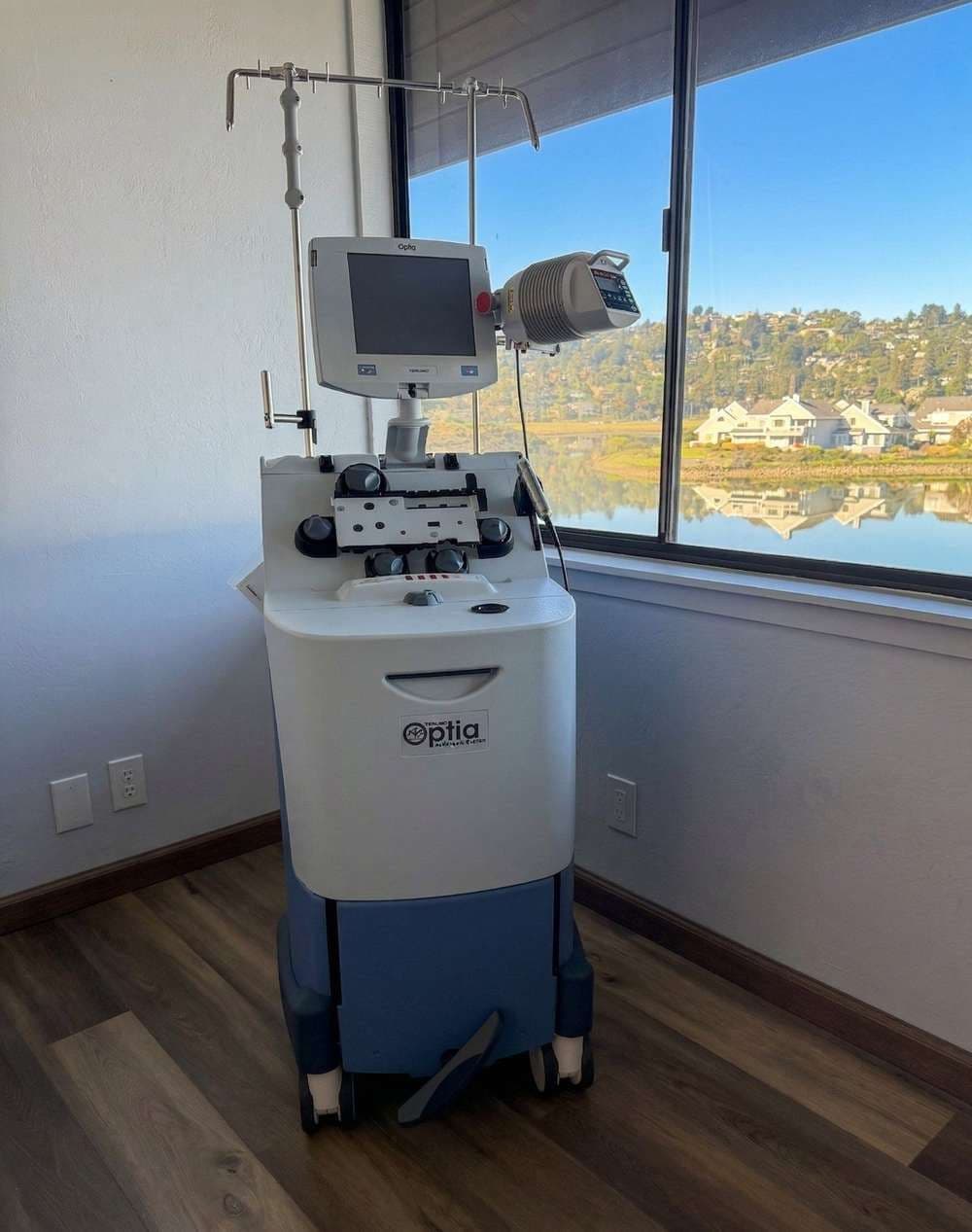
If you've been researching apheresis therapy online, you've probably encountered the term "inuspheresis." It comes up frequently in patient forums and longevity circles, particularly among people exploring options for Long COVID, autoimmune conditions, and biological aging. I get asked about it regularly.
This post explains what inuspheresis actually is, where it's available, and how it compares, both technically and clinically, to therapeutic plasma exchange (TPE).
If you have arrived here because of the death of Giorgos Mazonakis in Athens, which involved an inuspheresis device, I have written separately about what the published safety data show and what that case does and does not tell us. This post is about the technology itself.
In short: inuspheresis is a proprietary form of double filtration plasmapheresis, developed in Europe and not currently available in the United States. It returns your own albumin rather than replacing it, so anything albumin-sized or albumin-bound comes back with it. Therapeutic plasma exchange discards the plasma whole and replaces it with fresh albumin.
What Is Inuspheresis?
The underlying technique is not new. Double filtration plasmapheresis has decades of use, particularly in Japan, for transplant preparation, autoimmune disease, and lipid disorders. What makes inuspheresis distinct is the branded protocol and proprietary filter set built on top of it, developed in Germany and Switzerland. Like TPE, it is an extracorporeal blood purification procedure: blood is drawn from the patient, processed outside the body, and returned. European clinics use it primarily for chronic inflammatory conditions, environmental toxicity, post-viral syndromes, and cardiovascular risk reduction.
As of this writing, inuspheresis is not available as a standard clinical offering in the United States. Proxima Health, an Austin-based company, has signaled interest in bringing the technology to the American market, but it has not yet arrived. Patients searching for inuspheresis in California or elsewhere in the US will not currently find a provider.
For patients in the United States seeking this category of treatment, therapeutic plasma exchange is the established, FDA-cleared option with the deepest clinical and research foundation.
How TPE Works
To understand what makes inuspheresis different, it helps to understand how therapeutic plasma exchange is performed.
There are two distinct technologies used in plasmapheresis. The first, and the standard in the United States, is centrifugal. Blood is drawn into the machine and enters a spinning centrifuge, which separates its components by density. Red blood cells, being the densest, settle to the bottom. White blood cells collect in the middle. Plasma rises to the top. The machine then selectively removes the plasma, which is discarded and replaced with a therapeutic fluid, typically albumin. In hospital settings, fresh frozen plasma is sometimes used instead. There is no filter involved in this process.
The second technology is membrane filtration. A filter physically separates plasma from the cellular components of blood. In standard single-filtration plasmapheresis, the plasma is then discarded and replaced, functionally similar to centrifugal TPE in its outcome, if not its mechanism.
How Inuspheresis Works
DFPP builds on the filtration-based approach by adding a second filter. After the plasma is separated from the blood cells, it passes through a fractionator: a secondary membrane with a specific pore size. This fractionator is calibrated to trap large molecules while allowing smaller ones, including albumin, to pass through and be returned to the patient. Because most of the patient's own albumin is preserved, replacement fluid is generally not required.
Inuspheresis uses proprietary secondary filters, primarily the TKM58 and INUS 30, designed to target different molecular profiles. The TKM58 is oriented toward broad environmental detoxification: autoantibodies, inflammatory mediators, and protein-bound toxins. The INUS 30 targets lipoproteins and is used for cardiovascular applications, removing large fractions of LDL and fibrinogen to reduce blood viscosity.
The Case for Selectivity, and Its Limits
The appeal of DFPP and inuspheresis is intuitive: why remove everything when you can target just the pathogenic molecules? Preserving the patient's own plasma reduces the need for replacement fluids and lowers costs.
This logic holds in certain narrow indications, particularly lipid apheresis for familial hypercholesterolemia, where the target is well-defined and the filter can be calibrated precisely to catch it.
But it breaks down in the settings where most patients asking about inuspheresis are coming from: aging, Long COVID, autoimmune disease, and chronic systemic inflammation.
The Problem with Selective Filtration in Systemic Disease
This is the central clinical and scientific issue with selective filtration in the context of aging and systemic disease, and it is one the research community is only beginning to work through.
We know that plasma contains pro-aging, pro-inflammatory factors that accumulate over time and contribute to biological aging. Some of these have been identified: certain inflammatory cytokines, immune complexes, dysfunctional proteins. But the full catalog is unknown. We know these factors exist and that they matter not because we have mapped all of them, but because when we remove plasma broadly and replace it, without knowing exactly what we removed, tissues rejuvenate.
The animal evidence for this is striking. Heterochronic parabiosis experiments, in which the circulatory systems of old and young mice are surgically joined, demonstrated as early as 2005 that old tissue can be rejuvenated by exposure to a younger blood environment. For years the assumption was that young blood contained beneficial factors. But a landmark 2020 study published in Aging (Mehdipour et al.) overturned that interpretation. The researchers performed neutral blood exchanges on old mice, replacing their plasma not with young blood but simply with saline and albumin. A single exchange rejuvenated muscle, brain, and liver, tissues derived from all three embryonic germ layers. Pro-aging protein signatures decreased, pro-regenerative ones increased, and the benefits were comparable to what parabiosis had achieved. The implication was clear: you do not need to add anything from young blood. You need to remove what has accumulated in old blood. This is, in effect, the animal model of therapeutic plasma exchange.
The clinical translation followed. Dr. Kiprov's group demonstrated in the 2022 GeroScience study (Kim et al.) that old plasma dilution reduced measurable biological age in human patients. The 2025 Aging Cell study (Fuentealba et al.), also from Dr. Kiprov's research program, extended this finding using 35 epigenetic clocks, showing that TPE combined with IVIG produced an average reduction in biological age of approximately 2.61 years. These benefits emerged from broad, non-selective removal, not from targeting specific known molecules.
A selective filter can only remove what its pore size and membrane chemistry are designed to catch. If the molecule driving a patient's inflammatory burden or accelerating their aging process is not the right size, not the right charge, or simply not yet identified, it passes through. The filter does not know what it is missing. Neither do we.
TPE does not have this problem. It removes plasma comprehensively. Whatever is pathogenic, known or unknown, characterized or not, is cleared. The therapeutic benefit is not contingent on our current understanding of which proteins are responsible.
"A selective filter can only remove what it is designed to catch. TPE removes plasma comprehensively. The therapeutic benefit does not depend on our current understanding of which molecules are responsible."
What Passes Back Through the Filter
A selective filter has a floor, and that floor is albumin. Everything albumin-sized or smaller passes back to the patient, and so does anything bound to albumin, whatever its size. Two groups of molecules you would most want to clear fall into exactly that gap.
The first is the small inflammatory signals. The soluble cytokines that sustain chronic, low-grade inflammation, TNF-alpha, IL-6, IL-1beta, and IL-8, are all smaller than albumin. Inuspheresis removes the large immune components, the autoantibodies and immune complexes, but these small messengers slip below the cutoff and return with the albumin. The line is not even clean among the antibodies: IgM is large and comes out efficiently, but IgG, though still larger than albumin, sits closer to the fractionator's cutoff and is cleared far less completely, so a portion of pathogenic IgG autoantibodies can be left behind. Therapeutic plasma exchange draws off the plasma whole and makes none of these distinctions.
The second group is anything that travels bound to albumin. Preserving albumin is the entire design goal of DFPP, so any toxin riding on that albumin is preserved along with it. The clearest example is PFAS, the "forever chemicals," which are small and bind tightly to albumin: an apheresis built to return your albumin returns your PFAS with it. The same holds for other albumin-bound environmental compounds and protein-bound metabolic toxins.
This is not to say selective filtration removes nothing. It efficiently clears the large fraction it is tuned for, including LDL, fibrinogen, immune complexes, and even large particulates such as microplastics. The point is narrower: its selectivity is built around sparing albumin, and in sparing albumin it spares an entire class of things you would want gone. TPE has no floor and no albumin to protect. It removes the plasma comprehensively and returns fresh albumin in its place.
Albumin Replacement Is Therapeutic, Not Just Functional
DFPP's preservation of the patient's own albumin is frequently presented as an advantage over TPE. The picture is more nuanced than that.
The albumin returned to a patient after DFPP filtration is the patient's own aging, potentially dysfunctional albumin: molecules that have been circulating for weeks or months and may have accumulated oxidative modifications or toxic adducts.
The albumin infused during TPE is fresh, unmodified, and therapeutically active. Albumin is not merely a replacement fluid. It is the body's primary transport protein and one of its most important endogenous antioxidants and anti-inflammatory agents. It binds and sequesters substances that survived the exchange, compounds that may not have been removed in a single pass but are now bound and effectively neutralized until the next session. This buffering function is lost entirely when albumin replacement is eliminated from the protocol.
This is a point I find myself making often in consultations. Patients hear "you keep your own albumin" and assume that is better. In the context of aging and chronic disease, the opposite may be true. Fresh albumin is part of the treatment, not a compromise.
Practical Comparison
| TPE | Inuspheresis (DFPP) | |
|---|---|---|
| Mechanism | Broad plasma removal and replacement | Selective filtration by molecular size |
| Replacement fluid | Yes, therapeutic albumin | Generally not required |
| Albumin returned | Fresh, functional | Patient's own (potentially modified) |
| Unknown pathogens removed | Yes | Not reliably |
| Albumin-bound toxins (e.g., PFAS) | Removed | Returned with albumin |
| US availability | Yes, FDA-cleared | Not currently available |
| Research base | Extensive, decades of published data | Limited, primarily European |
| Aging/longevity evidence | Aging 2020, GeroScience 2022, Aging Cell 2025 | Not established |
What I Tell Patients
Inuspheresis is a genuinely interesting development in the apheresis field, and I follow its progress with professional interest. But it is not available in the United States, its selectivity is a limitation as much as an advantage in the conditions where patients are most interested, and the research foundation for its use in aging and chronic systemic disease does not yet exist.
For patients who have read about inuspheresis and are wondering whether something comparable is available to them now: the answer is yes. Therapeutic plasma exchange achieves broad, evidence-supported plasma purification with the added therapeutic benefit of fresh albumin replacement. It is the procedure I have supervised hundreds of times, and it is what I would choose for myself.
If you are exploring whether TPE might be appropriate for your situation, I am happy to talk it through.