On September 9, Giorgos Mazonakis died at 54 after going into cardiac arrest at a private medical practice in the Kolonaki district of Athens, where he had gone for a blood filtration procedure. He was one of Greece's most beloved singers, thirty years into a career that reached well past the music audience. Thousands came to his funeral. My condolences to his family and to everyone who loved his work.
In the days since, I have been asked the same question repeatedly, by patients, by colleagues, and now by people finding this site through search: is plasma exchange dangerous?
It deserves a real answer rather than a defensive one. I am a clinical pathologist who has performed over 500 therapeutic plasma exchange procedures. Here is what the published safety data actually show, what this case appears to be about, and what I think it should change.
INUSpheresis is not plasma exchange
Nearly every English-language report has used "plasmapheresis," "plasma exchange," and "blood cleansing" interchangeably. They are not the same thing, and the difference matters for reading the safety evidence.
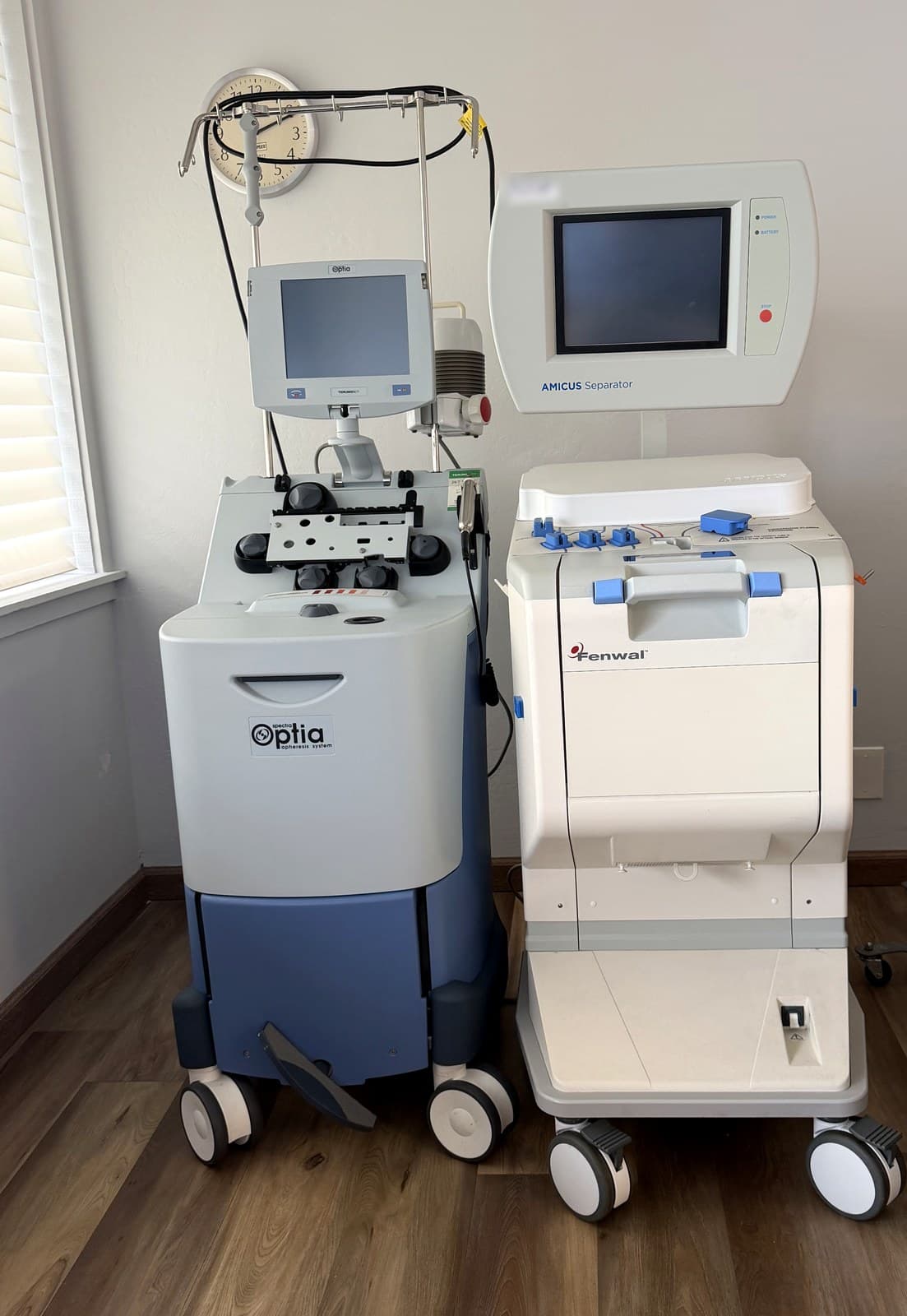
Greek case file reporting indicates the device in use was an INUSpheresis system. INUSpheresis is a proprietary form of double filtration plasmapheresis (DFPP). Plasma is separated from the blood cells, passed through a secondary filter that retains larger molecules, and then returned to the patient. Nothing is replaced.
Therapeutic plasma exchange (TPE), which is what I perform and what nearly all of the research below studies, works differently. Plasma is removed and discarded, and replaced with a fresh albumin solution.
Same category of technology, different procedures, different risk profiles, and very different evidence bases. Almost every safety figure quoted in coverage of this case comes from the TPE literature and was generated studying a procedure that was not the one being administered. I wrote about how the two compare in INUSpheresis vs. therapeutic plasma exchange, and that post has become one of the most-read things on this site over the past week for obvious reasons.
None of this suggests the device caused his death. It means the reassuring numbers and the frightening headlines are describing two different procedures, and neither is being applied carefully.
What's on the record so far
The investigation is ongoing. An autopsy was performed and was not able to establish a cause of death. Toxicological and histological testing is still pending. Two physicians have been charged with a felony offense of endangerment resulting in death. They deny responsibility, and they are entitled to the presumption of innocence and to due process.
I want to be precise about that, because a great deal of confident commentary is being published by people with no access to the evidence. I have none either.
What is on the public record, from officials rather than leaks:
- Greece's Health Minister has stated the practice was licensed as a general medical office and was not authorized to perform plasmapheresis. He has since described the procedure as one that should be carried out in a hospital setting, and ordered an inspection by the Athens Medical Association.
- Reporting on the case file describes a recorded 42-minute session on the machine, which is relevant because it bears on whether treatment had begun.
- Paramedics reportedly found the practice's defibrillator was not functional.
- The singer was transported to Elpis Hospital and pronounced dead at 5:40 p.m. The hospital has stated resuscitation was performed according to protocol without success.
More granular timeline details are circulating from the case file, including claimed timestamps and a photograph. I am not going to reproduce those here. They are contested evidence in a live prosecution, and a physician's blog is not the place to adjudicate them.
There is also a body of leaked material about his condition on the day, drawn largely from the accused physician's own statement and disputed by his family. I am leaving that alone as well. He is not here to consent to its publication, his family has objected to the characterization, and the clinical point I want to make does not require his medical details.
Sometimes the right call is not to treat
The point holds regardless of what toxicology eventually shows, and it is the one I would want a patient to take away from this.
The most important safety decision in apheresis is often the decision not to make one.
Any patient who presents for an elective procedure with new confusion, difficulty speaking, a new cough, unexplained fluid retention, or trouble standing is not a patient you treat that day. Those findings call for urgent evaluation. An apheresis program that cannot cancel a booked session has a structural problem, not a clinical one.
This is the part that is hardest to buy along with a machine. The equipment is available commercially. The judgment about when not to use it comes from training and volume.
Two ways to read what happened
Strip away the speculation and you are left with two broad possibilities.
The procedure was performed in a way that caused harm. Wrong replacement fluid, missing pre-treatment labs, unsuitable equipment, ignored alarms, or a patient who should not have been treated.
Or a cardiac event occurred that would have occurred anyway. Arrhythmias and myocardial infarctions happen at desks and on treadmills. Occurring during a procedure does not mean caused by it, and the distinction between complications that happen during treatment and complications caused by treatment is the single thing most often botched in discussions of apheresis safety.
The conclusion is the same either way, which is why I find this case clarifying rather than alarming.
If a cardiac event happens in a properly run apheresis unit, the team recognizes it in seconds, stops the circuit, begins resuscitation with equipment that has been checked that morning, and activates emergency services immediately. What separates a survivable event from a fatal one is usually the first several minutes. The setting does not determine whether the event happens. It determines whether the patient survives it.
How safe is plasma exchange, really?
Two things to understand before reading any of these numbers.
Most apheresis safety data come from very sick patients. TPE has been used in hospitals for decades for conditions including TTP, Guillain-Barré syndrome, myasthenic crisis, vasculitis with renal failure, and hepatic failure. Some of these patients are in intensive care. When one of them arrests, the illness is usually the reason.
The replacement fluid changes the risk substantially. Hospital TPE often uses donor plasma, which is required for conditions like TTP and carries the risks of any transfusion. Longevity and wellness protocols use albumin, which has a different risk profile entirely. Studies that pool both overstate the risk of albumin-based exchange.
With that framing:
Deaths attributed to the procedure itself are exceedingly rare. The World Apheresis Association registry covered 50,846 procedures in 7,142 patients, with no deaths attributed to the apheresis treatment. The often-quoted 0.05% figure (8 deaths in 15,658 procedures, Mokrzycki and Kaplan, 1994) counts deaths occurring in treated patients, drawn largely from the earlier hospital-based era, and pools plasma and albumin exchanges. It is not a measure of how often TPE kills a healthy person.
Serious complications are uncommon and cluster in sicker patients. In the WAA registry, 5.8% of procedures had an adverse event of any kind, most mild or moderate: citrate-related tingling, lightheadedness, nausea. Only 0.35% had a severe adverse event, and the rate varied by underlying disease, highest in renal patients at 1.0%. Severe arrhythmia occurred in roughly 2 per 10,000 procedures.
Albumin avoids most allergic risk. Mokrzycki and Kaplan found adverse reactions in 1.4% of albumin exchanges versus 20% of fresh frozen plasma exchanges. Albumin's characteristic weakness is hypotension, which is predictable and managed with attention to fluid balance.
AMBAR is the most relevant trial. In this randomized controlled trial, patients with Alzheimer's disease received plasma exchange with albumin replacement and no donor plasma. Across 4,709 procedures including sham procedures, at least one adverse event occurred in 16.9% of full-volume exchanges. These were minor: catheter site reactions, dizziness, transient hypotension. The investigators concluded the procedures were as safe and feasible in this older population as in other applications. TPE for Alzheimer's remains ASFA Category III.
Evidence for INUSpheresis specifically is thin. DFPP as a category has decades of use, particularly in Japan, for transplant preparation, neurological and autoimmune conditions, and lipid disorders, and published experience suggests it is generally safe in trained hands. Its characteristic risks are hypotension and, because the filters remove fibrinogen along with the targets, bleeding if clotting factors fall too far. For INUSpheresis as a branded protocol, the published literature is small observational work from European centers. There is no registry or randomized trial comparable to what exists for TPE.
So: performed correctly, with albumin, in people who are not acutely ill, serious complications from TPE are measured in fractions of a percent, and deaths caused by the procedure are exceedingly rare.
The machine is the easy part
That safety record has an unintended consequence. Because TPE is so safe in expert hands, it looks easy. A clinic buys a machine, a sales representative trains the staff over a weekend, and plasma exchange goes on the service menu.
TPE is safe because trained people manage its risks continuously:
- Citrate anticoagulation lowers ionised calcium. Too low affects cardiac conduction. It must be anticipated and replaced, not discovered.
- Fluid shifts drop blood pressure quickly, particularly in patients who are dehydrated, on antihypertensives, or have cardiac disease.
- Machine alarms are specific. Clotting, pressure, and air alarms each require a defined response. A circuit should never be left running while the cause is investigated.
- Pre-treatment screening is the procedure, as much as the exchange is: current labs, cardiac history, medication review, and a judgment about today.
- Emergency readiness is a checked item, not an assumption. Certified staff, drugs and equipment in the room, verified working, with a plan for activating emergency services immediately.
None of this is difficult for a team that does this daily. All of it is dangerous for a team that does not.
Who should be supervising this
In the United States, therapeutic apheresis sits within transfusion medicine. That is a formal subspecialty, and it is part of the training of clinical pathologists and transfusion medicine specialists. It is the discipline that oversees apheresis services in hospitals.
That is worth knowing because "longevity clinic" is not a credential and neither is ownership of an apheresis machine. The relevant question is not whether a physician is present in the building. It is what that physician was trained to do.
If you are considering plasma exchange anywhere, these are the questions I would ask:
Question four is the one that separates a clinical program from a retail one. Any clinic worth using will answer all six without hesitation.
The part worth arguing about
Greece's Health Ministry has announced a committee on longevity medicine, proposed advertising restrictions, and promised a public tool for checking what clinics are licensed to perform. Whether that is the right response is a policy question, and I am not going to pretend to settle it here.
What I am confident about is the underlying problem this case made visible. Apheresis works, the evidence supporting it is stronger than most people realize, and the gap between owning the equipment and knowing how to use it is wider than the market currently reflects. Those three facts together are how a therapy with an excellent safety record ends up associated with a death.
That gap closes faster through informed patients than through anything else. A clinic that cannot answer the six questions above will struggle to keep booking patients who know to ask them.
What has been reported about that practice in Kolonaki, if it holds up in court, describes a setting without the three things any apheresis program requires: staff trained specifically in apheresis, functional emergency equipment, and a threshold for stopping. Whether the procedure contributed to his death is a question for the forensic investigation, and I will not preempt it. But the standards question does not depend on that answer, and it is the one the field should be talking about.
To learn more about the procedure itself, see what therapeutic plasma exchange is and how it works and the clinical evidence base.
I practice at Global Apheresis in Mill Valley, California, where I serve as Associate Medical Director. If you have questions about whether TPE is appropriate for you, a discovery call is the place to start.